

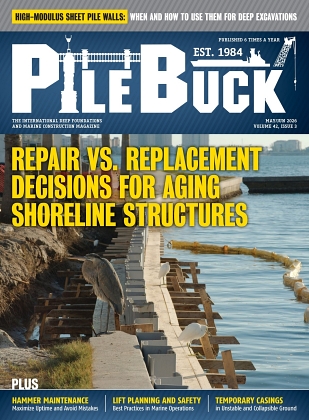



Repair vs. Replacement Decisions for Aging Shoreline Structures
View the complete article here.
Aging seawalls and bulkheads line thousands of miles of U.S. coastline, ports, and waterfront properties. Many were built decades ago and are now showing their age through cracking, leaning, toe scour, or loss of backfill. For marine contractors, these structures represent a steady stream of work—but also a critical decision point on every job: repair the existing system or recommend full replacement?
Start with a Thorough Condition Assessment
Before any pricing or recommendations, conduct a detailed inspection. Walk the structure at low tide, probe for voids behind the wall, measure lean and deflection, and document scour at the toe. Pay special attention to interlock condition on steel sheet piles, rot in timber, and spalling or cracking in concrete. Use underwater cameras or divers when necessary to evaluate submerged portions.
Look for red flags that often tip the scale toward replacement: significant loss of backfill, active piping, severe corrosion on steel (especially at the splash zone), or widespread timber deterioration. Minor cracking or localized scour, on the other hand, may be repairable with targeted intervention. Document everything with photos and measurements—this becomes your best defense if the owner later questions the recommendation.
Evaluate Repair Options and Their Limitations
Many aging structures can be successfully repaired and extended for years. Common methods include installing new tiebacks or helical anchors to restore lateral support, placing toe protection such as riprap, grout bags, or small sheet pile extensions, patching or encasing corroded steel with fiber-reinforced polymer or concrete jackets, and adding a new cap or wale system to improve load distribution.
Repair is usually faster and less expensive in the short term, and it minimizes disruption to the owner’s property or operations. However, it rarely restores the wall to “like-new” condition. If the structure is already badly compromised or the soils behind it have become unstable, repairs may only buy time before the next failure occurs. Experienced crews know that repeated repairs on the same wall can become more expensive than replacement over time.
Know When Replacement Makes More Sense
Full replacement becomes the better long-term choice when the existing wall has reached the end of its service life or when repair costs begin to approach 60%–70% of replacement. Other strong indicators include severe and widespread corrosion or section loss, ongoing loss of backfill that cannot be economically stopped, changes in site conditions (higher water levels, increased boat traffic, or new loading), or owner plans for significant upgrades to the property behind the wall.
Replacement allows contractors to install modern materials and designs—such as higher-strength steel, better coatings, or composite systems—that will last longer and require less future maintenance. It also provides an opportunity to improve the wall’s alignment, embedment depth, or drainage, addressing root causes that repairs alone cannot fix.
Key Decision Factors Contractors Should Weigh
Experienced crews evaluate several practical considerations before presenting options to the owner:
- Cost and schedule: Repair is almost always cheaper and faster upfront, but replacement may offer better value over 20–30 years.
- Permitting and environmental impact: Repair often qualifies for maintenance permits with less scrutiny, while replacement may require new environmental reviews and longer lead times.
- Site access and disruption: Replacing a wall usually requires more equipment and longer closures of the waterfront area.
- Owner’s goals and budget: Some owners want the lowest first cost—others prioritize longevity and minimal future maintenance.
- Risk tolerance: In high-visibility or high-liability locations, replacement often reduces long-term risk.
Permitting and Regulatory Considerations
Permitting realities can heavily influence the final decision. Many jurisdictions treat minor repairs as routine maintenance with streamlined approvals—while full replacement may trigger more rigorous reviews, environmental impact statements, or mitigation requirements. Savvy contractors factor these timelines and costs into their recommendations early. In some cases, a well-planned repair can be completed months before a replacement would even receive permits.
Making the Recommendation with Confidence
The most successful contractors present both options clearly—with pros, cons, expected service life, and a simple side-by-side comparison showing initial cost versus long-term cost, along with photos of similar projects they’ve completed. This positions you as a trusted advisor rather than just another bidder.
Repair and replacement decisions are rarely black and white, but a consistent evaluation framework helps you deliver honest recommendations and win more work from owners who value your expertise.
View the complete article here.
How do you determine whether a seawall should be repaired or replaced?
A seawall should be evaluated based on its structural condition, repair costs, remaining service life, and the extent of damage such as corrosion, scour, or backfill loss.
What are the signs that a seawall or bulkhead needs replacement?
Severe corrosion, significant leaning, ongoing backfill loss, major structural deterioration, and repair costs approaching replacement costs are common indicators that replacement may be the better option.
