

Enhancing Structural Capacity With H-Pile and Sheet Pile Hybrid Systems
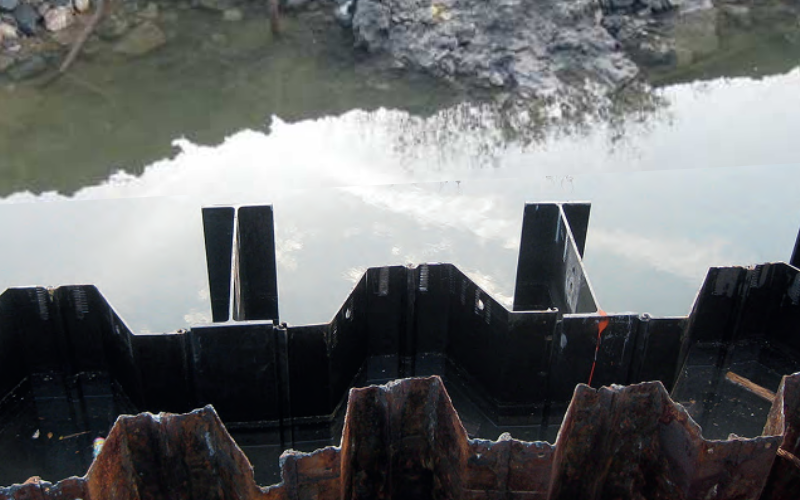
Retaining walls and deep excavation support systems are fundamental to many civil infrastructure projects. Traditional sheet pile walls have been used for decades to hold back soil and water in marine docks, cofferdams, basements, and flood protection projects. However, when engineers encounter projects requiring large retained heights or heavy lateral and vertical loads, the inherent capacity limits of conventional sheet piles become a constraint. That is where hybrid systems combining H-piles and sheet piles have found their place, offering increased stiffness, greater bending resistance, and the ability to reach deeper bearing strata while maintaining wall integrity and performance. These combined systems take advantage of the relative strengths of each component and are now common in situations where solo sheet piles may not suffice.
Understanding Hybrid Walls
Composite Action of King H-Piles and Sheet Piles
In a hybrid wall system, structural H-piles act as the main load-bearing members while intermediary sheet piles function as infill elements that transfer loads from soil and water pressures to the H-piles. The concept of a combined wall is not new in deep foundation engineering. When standard sheet pile walls lack sufficient strength for high loads or large retaining heights, a combined arrangement with king piles such as H-beams is used to provide structural support that is superior to either component alone. The H-piles are typically spaced at regular intervals and extend to depths chosen to meet bearing requirements, whereas the sheet piles help with earth retention and water control along the face of the wall. In this configuration, intermediary sheet piles can often be shorter than the primary H-piles, sometimes being only 60 to 100 percent of the king pile length while still contributing vital structural functions. This synergy enables what is called combined structural behavior, ensuring that loads are more effectively distributed across the wall elements.
Higher Structural Rigidity
A major reason hybrid H-pile and sheet pile walls are chosen over conventional sheet pile walls is their increased stiffness. Stiffness refers to the resistance of a wall to deformation under lateral loads from retained soil and hydrostatic pressures. Ordinary interlocking sheet piles, while effective up to a point, primarily resist bending through the steel section modulus of the sheet piling. In a hybrid wall, the king H-piles provide a large section modulus and significantly greater moment resistance. This larger resilience to bending means hybrid systems have fundamentally higher structural rigidity, resulting in lower deflection values under the same imposed loads. This property is especially useful in marine environments and deep excavations, where lateral pressures can be severe and any excessive movement can jeopardize adjacent structures or operations.
Design Considerations For Hybrid Walls
Load Transfer Mechanisms
In the design of hybrid H-pile and sheet pile systems, the load transfer mechanism is at the heart of how these walls increase capacity. Soil pressures act on the face of the sheet pile elements first, and through the interlock connections, these pressures are transferred to the heavier H-piles. King H-piles are engineered to take most of the bending moments and vertical loads, which might arise from surcharge loads on top of the ground surface or from structures supported directly by the wall. Since the intermediary sheet piles do not carry the majority of these high forces, they can be relatively lighter sections focused on containment and sealing without compromising structural performance. This division of labor between pile types enhances the overall efficiency of the system, and results in a wall capable of resisting forces that a sheet pile wall alone would struggle with.
Reaching Competent Bearing Strata
Another technical advantage of using a hybrid system is the ability to extend H-piles deeper into competent soil layers or rock. Conventional sheet pile walls may be limited by the embedment required to provide adequate passive resistance, which can be impractical in weak or soft soils. Because H-piles can be driven to significant depths and can penetrate harder layers with lower risk of distortion, they provide access to better bearing conditions. This deeper penetration increases both lateral capacity and vertical load capacity, helping to stabilize tall or heavily loaded structures adjacent to the wall. The deeper reach of H-piles also allows for the wall system as a whole to act in a more integrated manner with the ground, reducing the need for extensive anchoring systems that might otherwise be necessary for high walls.
Applications and Performance
Marine and Deep Excavation Scenarios
Hybrid H-pile and sheet pile walls are widely used in demanding applications such as quay walls at ports, cofferdams for underwater construction, and excavation support for deep basements. In port construction, for example, the wall must resist not only soil pressure but also significant hydrodynamic forces and potential impact loads from vessels. The high section modulus and rigidity that come from the H-piles make hybrid walls attractive in these scenarios because they provide stability under dynamic conditions where flexibility could be detrimental. The sheet piles contribute by forming a watertight barrier and controlling soil movement between the H-piles. Their relative position and connection ensure that water pressures are balanced and that the system behaves as a unified structural element.
Reduced Deflection and Enhanced Durability
Beyond increased bending resistance, hybrid walls are also valued for their reduced deflection under load. This means the wall does not sway excessively when lateral forces apply, which is vital in protecting adjacent structures, sidewalks, and utilities. In addition, the ability of H-piles to carry vertical loads makes them suitable for integrated support of permanent structures, such as bridge abutments or foundations of buildings near excavation sites. As a result, hybrid walls are not just stronger but also more adaptable for projects that require long service life and long term stability. Because the intermediary sheet piles can be protected by coatings or corrosion control measures independently from the H-piles, these walls can be designed with durability in mind for harsh environments such as marine or contaminated soils.
Future Trends in Hybrid Wall Use
Integration With Modern Design Tools
As computational methods in geotechnical and structural engineering continue to evolve, the design and optimization of hybrid H-pile and sheet pile walls are also advancing. Modern finite element analysis and specialized retaining wall design software help engineers model how hybrid systems behave under complex loading conditions, including seismic forces and uneven soil pressure distributions. This analytical capability allows for more precise designs that leverage the full capacity of both H-piles and sheet piles, resulting in safer and more cost-effective walls.
Sustainability and Material Efficiency
Emerging practices in sustainability also influence how hybrid walls are designed. Rather than simply adding mass to increase strength, engineers are using more efficient layouts that optimize material use while meeting performance requirements. By understanding how loads travel through a hybrid system, designers can minimize excess steel and focus on performance-driven sections that maximize capacity per unit weight. This not only reduces cost but also the environmental impact of producing and installing materials.
Hybrid H-pile and sheet pile walls represent a significant evolution in retaining wall technology. By combining the strengths of H-piles as primary structural members with the containment functions of sheet piles, these systems deliver increased stiffness, greater bending resistance, deeper embedment capability, and improved performance in heavy loading and deep excavation environments. For infrastructure projects that demand a high capacity solution, combined steel wall systems provide engineered resilience that stands up to both soil and water pressures. As design tools and sustainable practices continue to improve, the use of hybrid walls is likely to expand further as engineers seek dependable solutions for challenging site conditions that go beyond the limits of traditional sheet piles.
What are the main benefits of hybrid H-pile and sheet pile walls over conventional sheet piles?
They provide higher stiffness, greater bending resistance, and can reach deeper, stronger soil layers.
Where are hybrid H-pile and sheet pile walls commonly used?
They are used in marine docks, deep excavations, cofferdams, and other high-load retaining wall projects.
