






The Role of Groundwater Flow in Sheet Pile Stability
View the complete article here.
Groundwater flow is one of the most critical factors influencing the stability and performance of sheet pile walls. Differences in water levels on either side of a wall create hydrostatic pressures and seepage forces that can significantly alter the effective stresses in the soil and the lateral earth pressures acting on the piling. Neglecting these effects can lead to unsafe designs, excessive deflections, or even complete failure. Careful evaluation of groundwater conditions is therefore essential for every sheet pile project.
Hydrostatic Water Pressure and Unbalanced Loads
When the water level on the retained (back) side of a sheet pile wall is higher than on the excavated (front) side, hydrostatic water pressure develops. This pressure increases linearly with depth below the higher water surface, forming a triangular distribution similar to that of a uniform surcharge. It must be added directly to the active earth pressure diagram on the retained side and subtracted from the passive pressure diagram on the excavated side.
The net horizontal force due to water is the difference between the two triangular pressure blocks. If this unbalanced force is ignored, the total lateral load on the wall can be severely underestimated, leading to inadequate penetration, excessive bending moments, or anchor loads that exceed design capacity. Conversely, when water levels are equal on both sides, the hydrostatic pressures cancel each other out, and no net horizontal force from water remains.
Steady-State Seepage and Its Effects
Whenever a head difference exists, steady-state seepage occurs around the sheet pile. Water flows from the higher to the lower side, following curved paths that typically pass beneath the wall tip. The flow is governed by Darcy’s law, which states that seepage velocity is proportional to the hydraulic gradient. In sheet pile applications, the gradient varies along the flow path, and the flow lines are not straight, making accurate analysis essential.
Seepage changes the effective stress conditions in the soil. Below the water table, the effective unit weight of the soil is reduced to its buoyant (submerged) unit weight—the saturated unit weight minus the unit weight of water. This reduction lowers both active earth pressures on the retained side and passive resistance on the excavated side. Failure to account for the buoyant unit weight can result in overestimating active pressures and underestimating passive pressures, producing overly conservative or dangerously un-conservative designs.
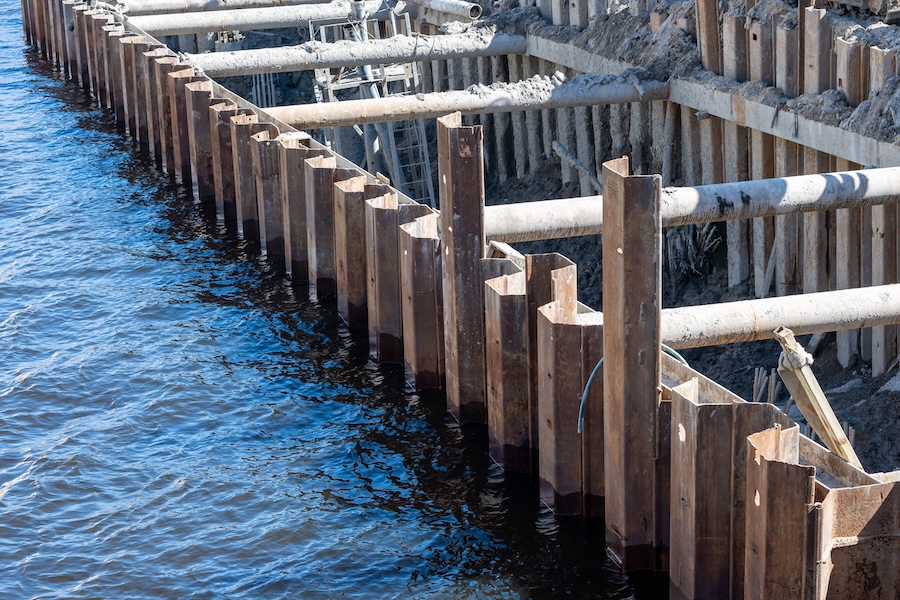
Seepage Forces
Seepage exerts body forces on the soil skeleton in the direction of flow. The magnitude of this force per unit volume is equal to the hydraulic gradient multiplied by the unit weight of water. Depending on the direction of flow, these forces can either increase or decrease effective stresses:
- Downward seepage (common behind the wall) increases effective stresses, thereby enhancing passive resistance on the front side and improving stability.
- Upward seepage (common in front of the wall) reduces effective stresses, decreasing passive resistance and raising the risk of bottom heave or piping.
In granular soils, high upward hydraulic gradients at the excavation base can cause boiling or piping, where soil particles are carried away by the escaping water. This loss of soil reduces passive resistance and can lead to progressive failure of the wall.
Analysis Methods for Groundwater Flow
Engineers use several methods to evaluate groundwater flow and incorporate its effects into sheet pile design:
- Simplified Method: This conservative approach assumes hydrostatic conditions without flow. It is useful for quick preliminary estimates but may overestimate or underestimate forces in certain cases.
- Flow Net Technique: A graphical method that involves sketching flow lines and equipotential lines to form curvilinear squares. The flow net provides reliable values for exit gradients, seepage quantities, uplift pressures, and pore pressure distributions along the wall. It is widely used for its accuracy and visual clarity.
- Finite Element Analysis: A powerful numerical method that solves the governing equations for complex geometries, layered soils, or irregular boundaries. It delivers detailed pore pressure distributions and is particularly valuable when traditional flow nets are difficult to construct.
These methods allow designers to develop realistic earth pressure diagrams that properly reflect both hydrostatic and seepage-induced pore pressures.
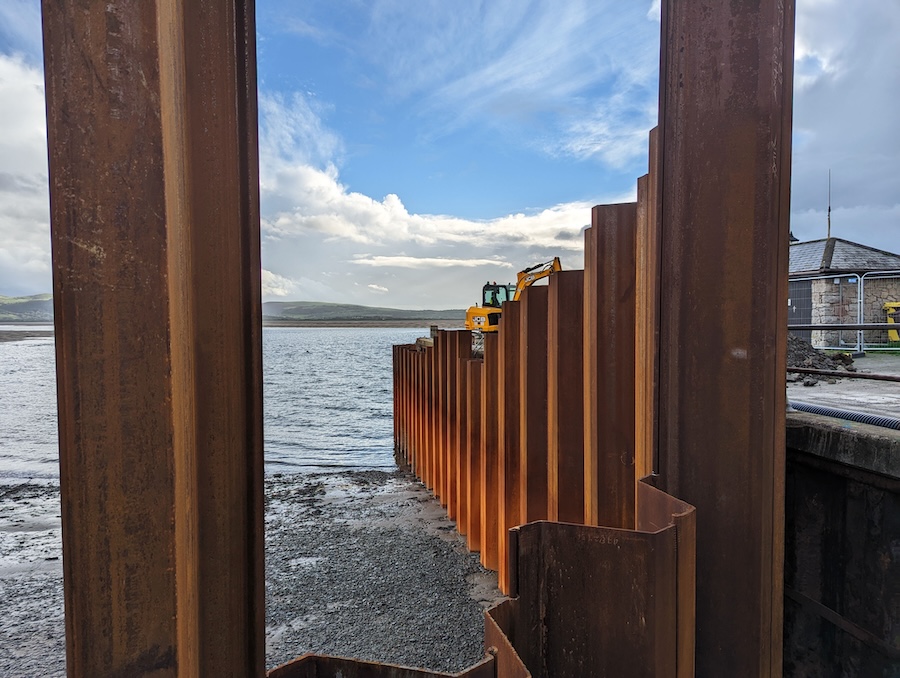
Seepage Through Interlocks
Steel sheet pile interlocks are not completely watertight. Water can leak through the joints, especially under high differential heads. While leakage reduces the unbalanced hydrostatic pressure, it can also cause soil erosion or loss behind the wall if the flow is uncontrolled. In temporary applications, limited seepage through interlocks is sometimes tolerated, but for permanent structures, interlocks are commonly sealed with bitumen, polyurethane, or other sealants to minimize leakage and prevent long-term soil loss.
Practical Implications for Design
Proper groundwater analysis is fundamental to safe and economical sheet pile design. Engineers must consider both pure hydrostatic cases and steady-state seepage conditions to ensure that safety factors are met under realistic field conditions.
Common design errors include:
- Neglecting upward seepage forces in the passive zone, leading to an overestimation of stability.
- Failing to account for downward seepage that increases passive resistance, resulting in an underestimation of stability.
By using flow nets, finite element analysis, or even conservative simplified methods, designers can develop accurate pressure diagrams and select appropriate sheet pile sections, penetration depths, and anchor systems.
In summary, groundwater flow is not a minor detail—it is a primary driver of sheet pile behavior. Accurate assessment of water levels, seepage paths, hydraulic gradients, and resulting forces is necessary to create stable, efficient, and long-lasting sheet pile structures that perform reliably under actual operating conditions.
View the complete article here.
How does groundwater affect sheet pile wall stability?
Groundwater creates hydrostatic and seepage forces that alter soil pressures and can cause wall deflection, bottom heave, or failure if not properly accounted for.
What methods are used to analyze groundwater effects on sheet piles?
Engineers use simplified hydrostatic calculations, flow nets, or finite element analysis to evaluate seepage, pore pressures, and lateral earth forces.
