

INTERVIEW: Everpads
Pile Buck speaks with EVERPADS, a construction replacement-parts specialist built on more than 90 years of rubber and manufacturing heritage. Today, EVERPADS develops field-driven solutions for road construction, earthmoving, compaction, and foundation equipment used in more than 80 countries.
PB: How did EVERPADS get its start?
EVERPADS: The technical heritage behind EVERPADS began three generations ago with the development of solid rubber tires for agricultural equipment.
That experience was later applied to construction machinery, where tires and rubber components had to withstand heavier loads and much harsher working conditions.
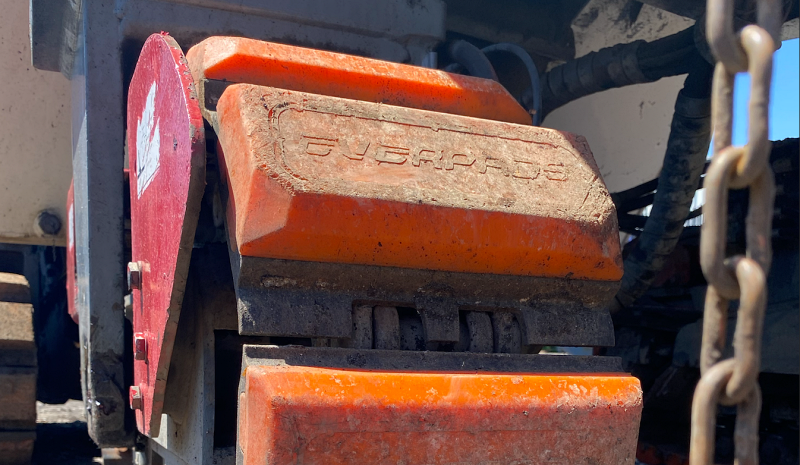
EVERPADS was formally established in 1995 after our founder, Leo Chiang, identified the inefficiency of conventional chain-on track pads. In 1999, we introduced our bolt-on track pad to make replacement faster, simpler, and more cost-efficient.
PB: What drove EVERPADS to expand from rubber products into a broader range of heavy-equipment parts?
EP: It was part of the company’s long-term vision.
Leo saw that contractors were often caught between premium-priced OEM parts and low-quality replacement products that could create premature wear, repeated maintenance, and unexpected downtime.
He believed contractors needed another option: professionally engineered replacement parts that could deliver reliable performance and longer service life without unnecessary premium pricing.
That principle became the foundation for EVERPADS’ expansion.
PB: Does that mean EVERPADS is primarily a cost-efficient aftermarket brand?
EP: Cost-efficiency is important, but our purpose is not simply to manufacture cheaper parts.
Every product must provide meaningful value through durability, performance, practical innovation, or reduced maintenance risk.
We want customers to evaluate the total operating result—not only the initial purchase price.
PB: How would you describe the company’s position today?
EP: EVERPADS is a construction replacement-parts specialist.
Our benchmark is not the lowest-priced aftermarket product. We compare our engineering, reliability, and performance with the standards contractors expect from leading OEM products.
At the same time, we look for opportunities to improve conventional designs and help customers achieve better performance without paying an unnecessary premium.
PB: Who is the primary EVERPADS customer?
EP: We serve contractors, equipment owners, fleet managers, mechanics, dealers, and manufacturers who care about building high-quality infrastructure.
These professionals are responsible for project schedules, equipment availability, maintenance costs, and production results.
Our role is to help them focus on the work instead of worrying about premature part failures.
PB: How broad is the EVERPADS product range today?
EP: We develop replacement parts for asphalt milling machines, pavers, excavators, compactors, vibratory hammers, and other heavy construction equipment.
Our portfolio includes rubber buffers, undercarriage components, rubber and polyurethane track pads, milling teeth, milling drums, conveyor belts, auger blades, and other wear components.
PB: Since many Pile Buck readers work with foundation equipment, let’s begin with your rubber-buffer products. What does EVERPADS offer?
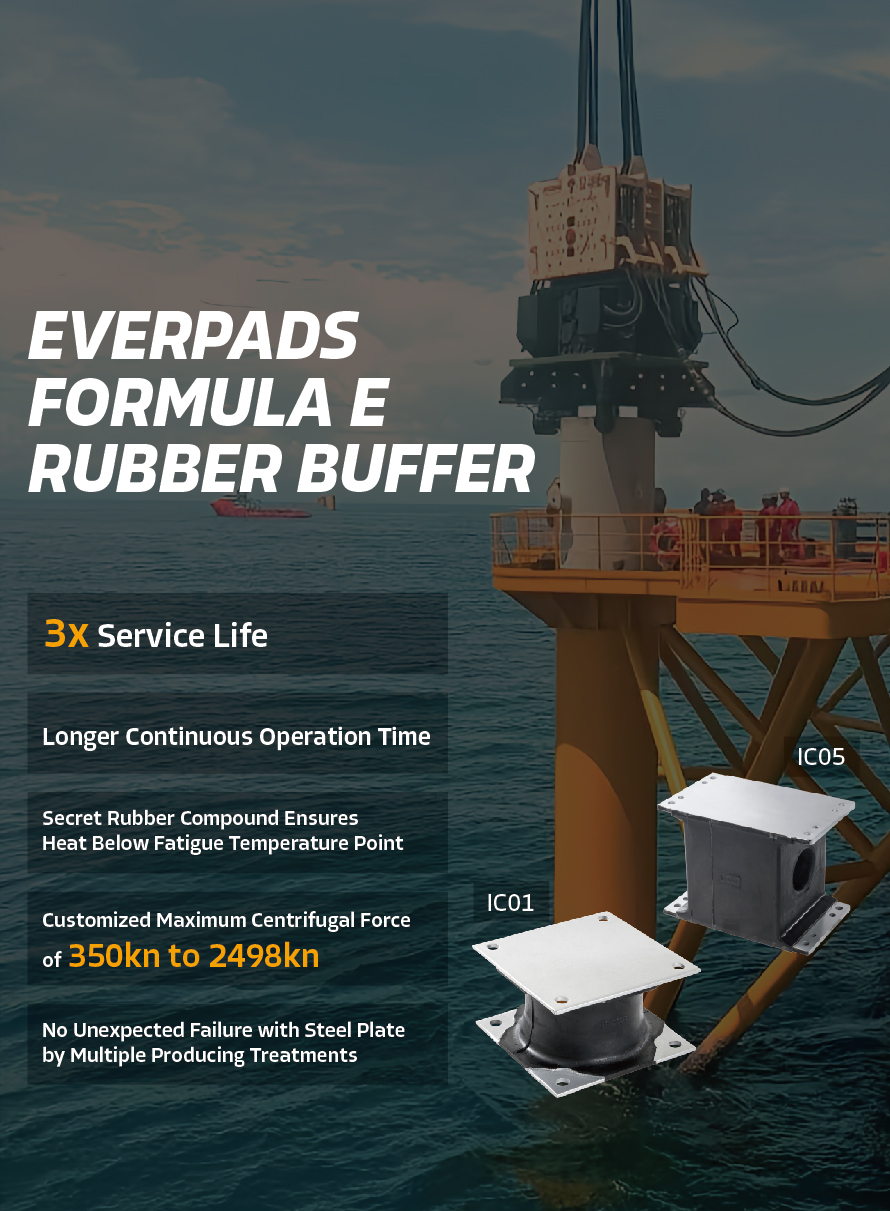
EP: One of our primary solutions is the IC05 rubber-buffer series for vibratory hammers.
These buffers are designed to absorb repeated dynamic force while maintaining stability under heat, compression, vibration, and continuous operating cycles.
The challenge is not simply producing a hard piece of rubber. The compound must control heat while continuing to deliver the required damping performance.
PB: Why is heat control so important?
EP: Excessive internal heat is one of the main causes of rubber fatigue.
As temperature rises, the material can begin losing its mechanical properties, which accelerates cracking, deformation, and premature failure.
Our Formula E compound technology is designed to control heat generation and keep the rubber below its critical fatigue-temperature range.
PB: What operating temperature does the IC05 target?
EP: The Formula E compound is designed to keep the operating temperature around 63 degrees Celsius, or 145 degrees Fahrenheit, under the intended conditions.
By reducing heat accumulation, the buffer can maintain its structure and damping performance for a longer period.
Under appropriate application conditions, the IC05 has achieved up to three times the service life of conventional rubber buffers.
PB: What about the steel plate inside the buffer?
EP: The steel plate goes through multiple preparation and protection processes, including heating, plating, and corrosion-resistant treatment.
The connection between the rubber and steel is critical. A strong rubber compound cannot perform properly if the bonding surface or internal load-transfer structure fails.
We therefore treat the rubber, steel plate, bonding process, and geometry as one complete structure.
PB: EVERPADS also developed a customized rubber buffer for Starke. What did that project involve?
EP: Starke needed a higher-force rubber-buffer solution for its SV Series suspended vibratory pile hammers.
The product had to support equipment with centrifugal-force requirements ranging from approximately 350 kN to 2,498 kN, allowing the machine range to serve heavier non-residential construction applications.
We developed the IC108-9 around the machine geometry, loading, vibration behavior, and target operating conditions.
PB: Is that typical of how EVERPADS approaches customization?
EP: Yes.
We do not begin by asking which existing catalog item we can sell. We begin by understanding the machine, force, failure mode, operating environment, and expected result.
That allows us to develop or recommend a solution based on the actual application.
PB: Let’s move to the Generation E Undercarriage System. What is its main purpose?
EP: Undercarriage components should not be treated as completely independent parts.
Rollers, chains, pads, sprockets, and idlers operate through continuous contact. If one component is poorly matched or wears prematurely, it can affect the wear pattern and replacement timing of the whole system.
Generation E is designed around better component matching, controlled wear, and a more predictable replacement cycle.
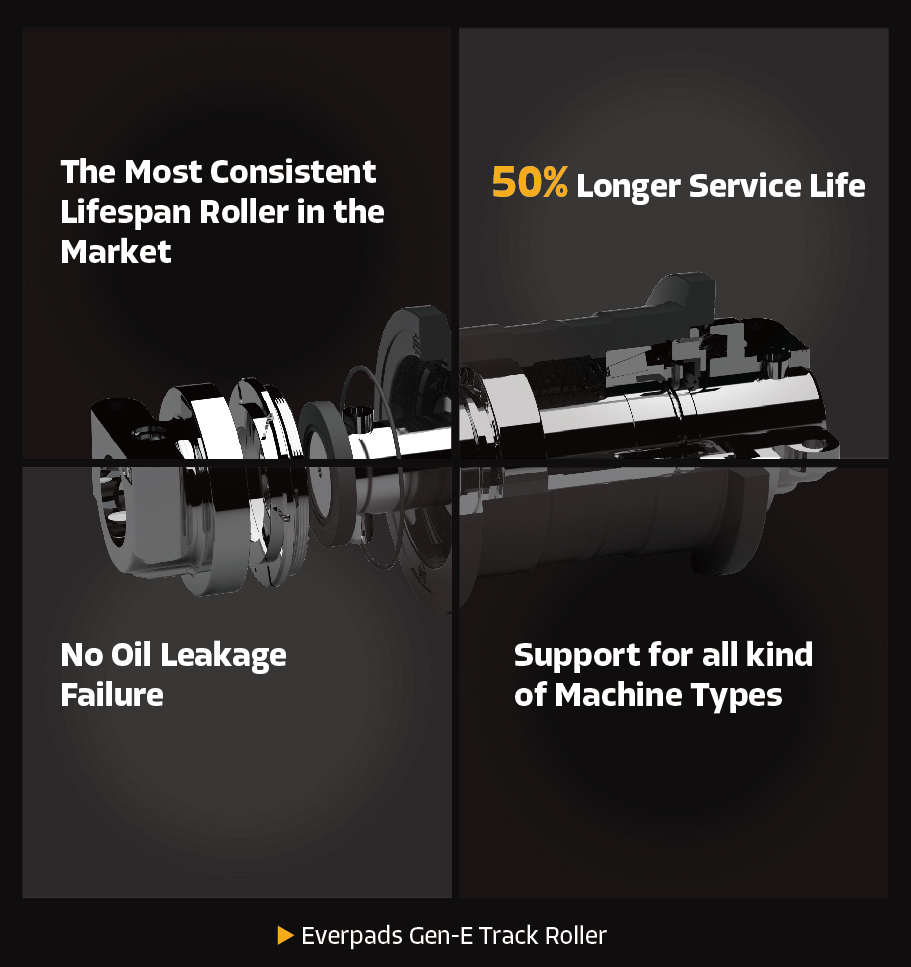
PB: What problem does the Generation E track roller address?
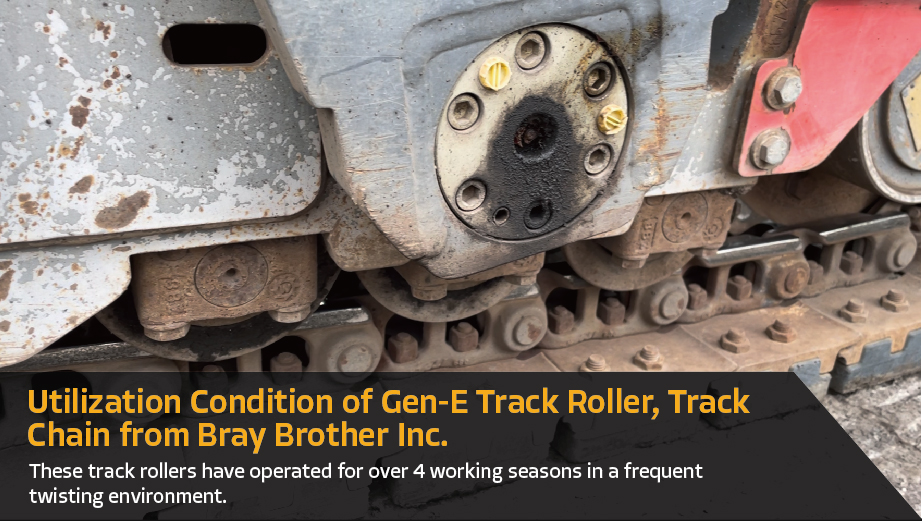
EP: Unexpected oil leakage is one of the most serious causes of track-roller failure.
Once lubricant escapes, internal friction and temperature rise. Bearings, shafts, and contact surfaces can then deteriorate rapidly.
The Generation E track roller uses a heavy-duty sealed structure designed to prevent up to 99 percent of common oil-leakage issues under normal operating conditions.
PB: The catalog also mentions a safeguard mechanism. How does that work?
EP: Construction machinery does not always operate under ideal conditions.
The machine may crush hard objects, experience side loading, or temporarily operate at an angle.
The Generation E sealing structure is designed to help retain lubrication even when the roller experiences an unexpected condition, reducing the risk that a single event immediately becomes a complete roller failure.
PB: What is the value of the tapered bearing system?
EP: Track rollers must manage both radial and axial loads.
They are exposed to machine weight, vibration, steering force, side loading, and uneven ground conditions.
The tapered bearing structure is designed to manage these combined forces more effectively while supporting stable movement and reducing unnecessary internal friction.
PB: What type of oil should be used with the roller?
EP: EVERPADS provides roller oil formulated for stable internal lubrication and controlled heat generation.
The roller structure, lubricant, installation, inspection, and maintenance all work together. Even a strong sealing system still requires the correct operating and maintenance practices.
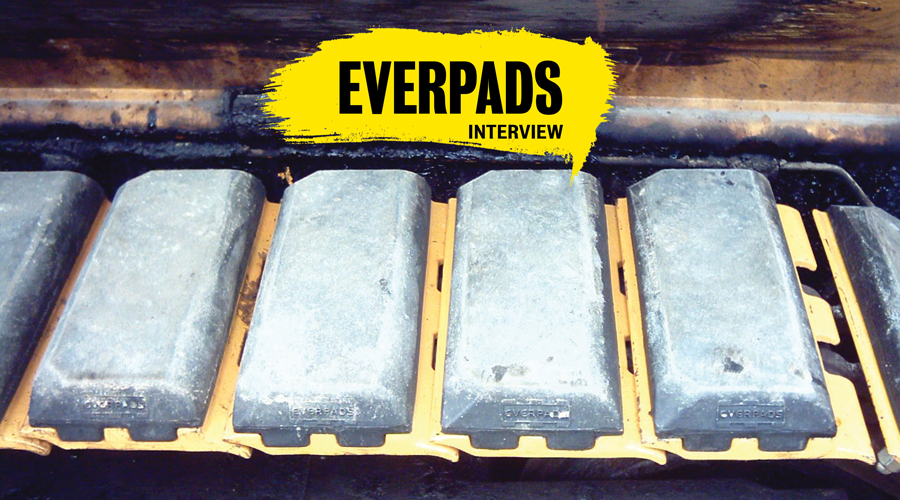
PB: Track pads remain one of EVERPADS’ best-known product categories. Tell us about the polyurethane pads for milling machines.
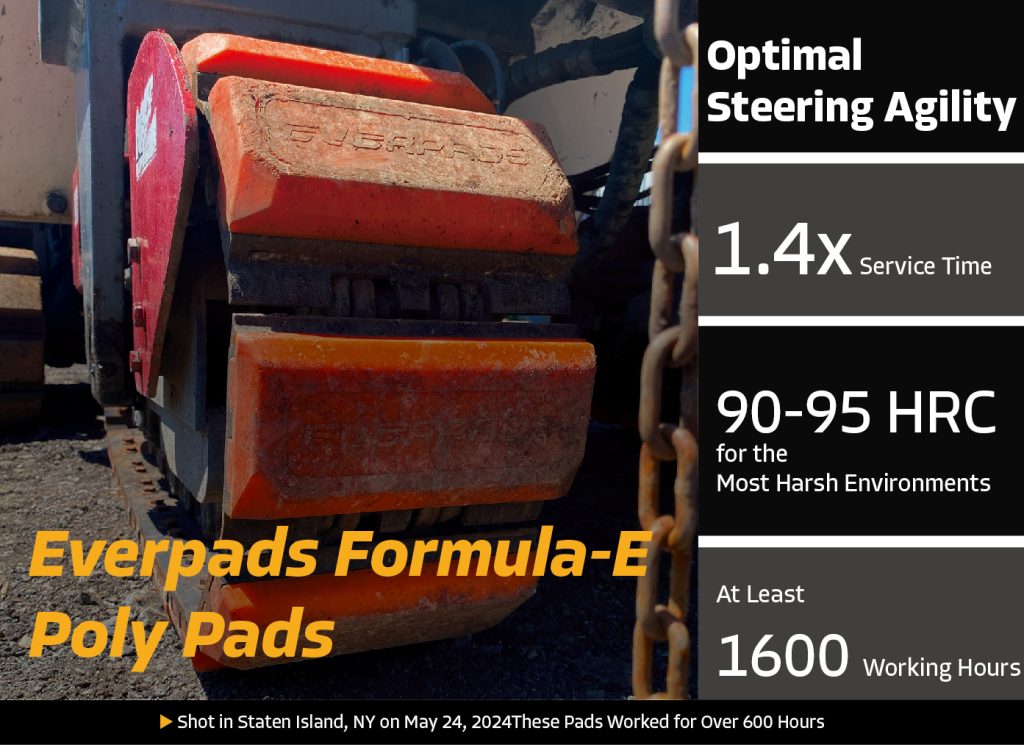
EP: The EV Series was developed specifically for the heavy loading and steering demands of asphalt milling machines.
The pads use an internal steel support structure to distribute load and reinforce the polyurethane body.
Our patented chamfered-edge design also reduces stress concentration during steering and helps control edge chipping.
PB: What is the benefit of the built-in steel plate?
EP: Polyurethane provides abrasion resistance and surface-contact performance, but the pad also needs a strong internal foundation.
The built-in steel plate and supporting frame improve load transfer and strengthen the connection between the polyurethane body and mounting structure.
This helps reduce deformation, separation, and unexpected breakage during high-load operation.
PB: What service life can customers expect?
EP: EV Pro has achieved more than 1,600 operating hours in field applications.
However, service life depends on machine weight, ground conditions, steering frequency, installation, maintenance, and operator behavior.
We provide different EV grades so customers can choose the most suitable balance between performance, operating conditions, and cost target.
PB: Why does EVERPADS use a bolt-on design?
EP: Bolt-on pads allow contractors to inspect and replace individual pads according to actual wear.
This can reduce installation time, inventory requirements, and the unnecessary replacement of components that are still serviceable.
Correct mounting-surface preparation, bolt torque, and regular inspection remain important.
PB: Do you also provide track pads for other machines?
EP: Yes. We develop rubber track pads for excavators, pavers, compactors, and other tracked equipment.
Each machine requires a different balance of material properties.
Excavators require cut resistance, traction, shock absorption, and steering control. Pavers require oil resistance, heat management, and stable contact with the paving surface.
PB: How do your rubber pads achieve a longer service life?
EP: Our low-heat rubber-compound technology is designed to reduce internal heat accumulation during continuous operation.
Heat is one of the main causes of rubber degradation. By controlling temperature and combining it with abrasion-resistant compounds and reinforced structures, the pads can maintain their mechanical properties for longer.
Depending on the application, EVERPADS rubber pads can provide approximately 30 to 40 percent longer service life than upper-medium-grade alternatives.
PB: Tell us about the Generation E Milling System.
EP: It is a coordinated range of components developed for asphalt milling machines.
The system includes milling teeth, holders, drums, conveyor components, scraper and protection components, and undercarriage products.
Milling performance is not determined by the cutting tooth alone. Tooth rotation, holder condition, drum geometry, material flow, machine stability, and undercarriage condition all affect production and surface results.
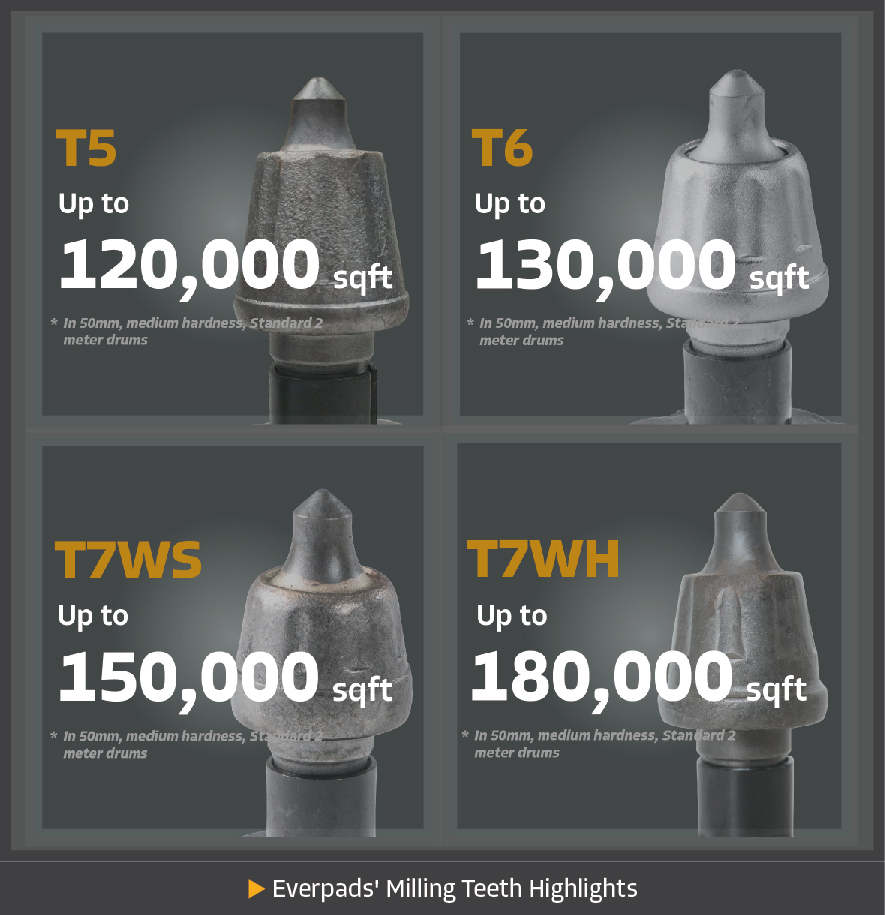
PB: What makes the Generation E milling teeth different?
EP: Stable rotation is one of our primary design priorities.
If a tooth stops rotating, wear becomes concentrated on one side of the carbide and steel body. This reduces carbide utilization, affects cutting performance, and can expose the holder to additional wear.
Our designs focus on rotation stability, carbide utilization, body strength, wear-plate protection, and correct fit within the holder.
PB: What materials are used?
EP: The steel body is designed to withstand repeated impact, vibration, and heat.
The tungsten-carbide tip uses high-quality raw materials selected to maintain cutting performance in demanding asphalt and aggregate conditions.
However, material quality alone is not enough. Geometry, manufacturing consistency, brazing, retention, and application matching are equally important.
PB: Can you share a field example?
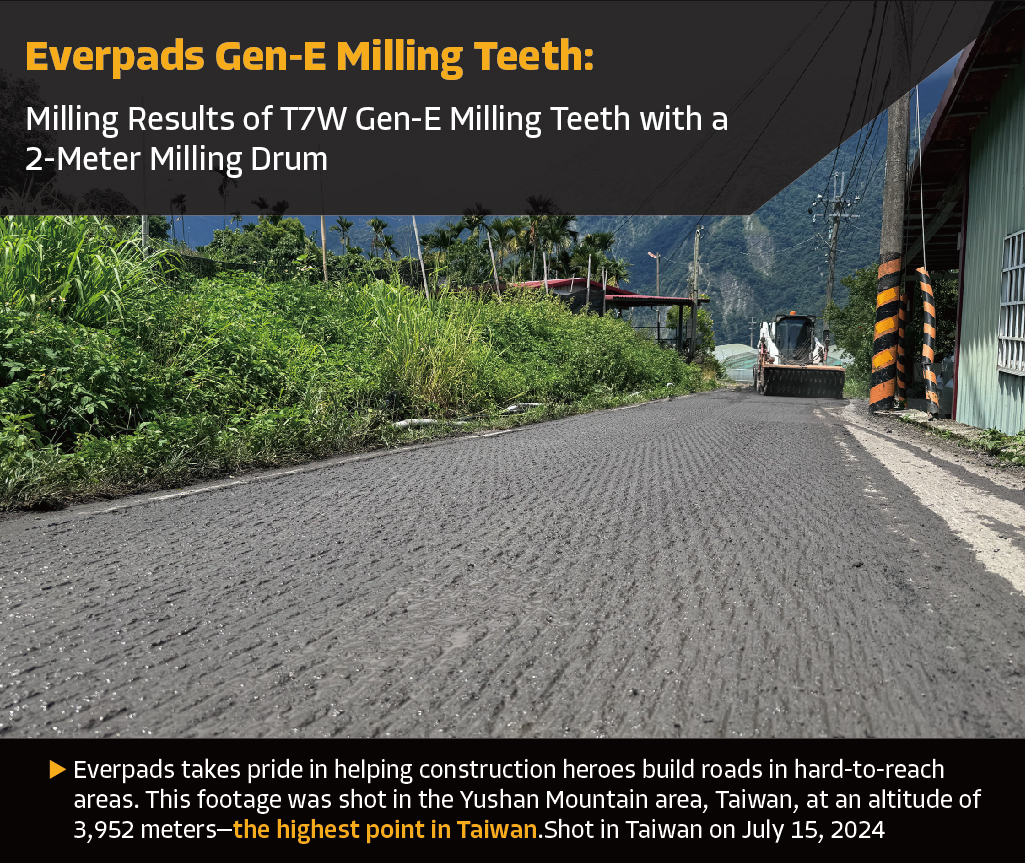
EP: Hesheng Road Construction used Generation E T6 milling teeth while milling very hard asphalt concrete in Taiwan with a Wirtgen W 100.
Under the tested conditions, the contractor reported approximately 40 percent lower cutting-tool cost while maintaining the required production performance.
We treat field cases as application evidence rather than universal guarantees because results depend on the machine, material, cutting depth, operator, and project target.
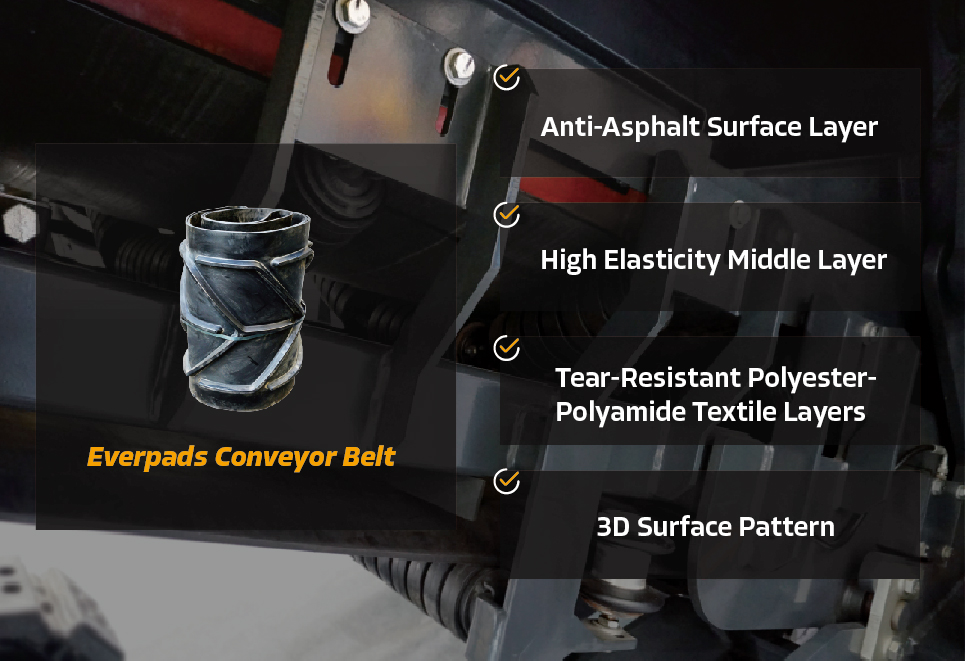
PB: EVERPADS has manufactured milling-machine conveyor belts since 1999. What are their main features?
EP: A milling-machine conveyor belt must manage abrasion, impact, asphalt adhesion, heat, tension, and continuous flexing.
Our belt structure combines an anti-asphalt surface layer, an elastic middle layer, and reinforced polyester-polyamide textile layers.
Depending on the application, the internal structure may contain up to five reinforcement layers.
PB: What is the purpose of the three-dimensional pattern and Y-shaped reinforcement?
EP: The three-dimensional pattern helps improve material movement across the belt.
The Y-shaped reinforcement helps distribute force through the internal structure and reduce localized stress.
The design must balance strength, flexibility, tracking stability, and material-flow performance.
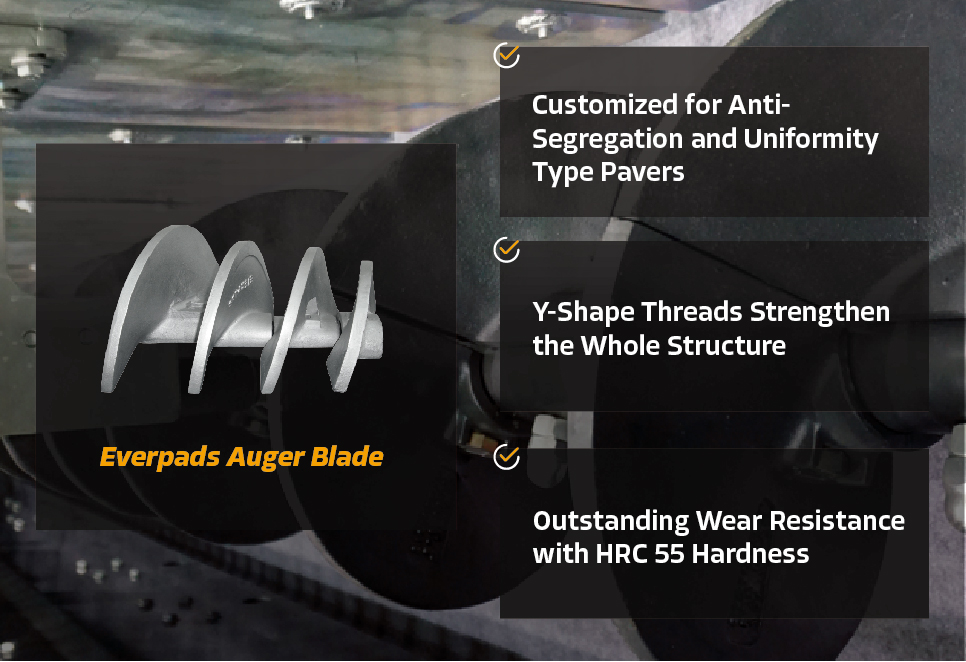
PB: What type of auger blades does EVERPADS provide?
EP: We manufacture auger blades for a broad range of paver makes and models.
The blades use precision casting and controlled heat treatment to provide strong wear resistance. Depending on the product specification, the target hardness is approximately HRC 55.
However, hardness is only one factor. Geometry, pitch, alignment, and casting accuracy also influence material flow and paving quality.
PB: Can the auger blades be customized?
EP: Yes.
Our engineering team can adjust the blade geometry, pitch, diameter, or installation configuration according to the machine and paving requirements.
The objective is to support consistent material distribution and reduce segregation risk across the paved surface.
PB: What sets EVERPADS apart from other replacement-parts manufacturers?
EP: We combine manufacturing control with field-driven problem solving.
A contractor’s challenge is rarely limited to one damaged part. It may include lost production, repeated replacement labor, surrounding-component damage, inventory shortages, or a product that was not properly matched to the application.
Our responsibility is to understand the broader operating problem and provide a solution that supports the customer over time.
PB: Do you see EVERPADS as a manufacturer or a technical partner?
EP: We are both.
Manufacturing capability allows us to control materials, processes, product consistency, and development.
But customers also need application support, machine matching, failure analysis, product selection, customization, and long-term replacement planning.
We want customers to see EVERPADS as a construction-parts consultant—not simply a supplier of catalog numbers.
PB: How does sustainability fit into the EVERPADS business?
EP: In replacement parts, the most practical form of sustainability is extending useful service life.
When a component lasts longer, fewer parts need to be manufactured, transported, installed, and discarded. Contractors also experience fewer maintenance interruptions and can complete more work with the same equipment.
For us, durability, cost-efficiency, and sustainability are directly connected.
PB: What would you like Pile Buck readers to remember about EVERPADS?
EP: Every machine, project, and operating environment is different.
Our role is not to push the same product into every application. It is to understand the machine, working conditions, performance target, and cost of failure—then recommend or develop the right solution.
As our founder, Leo Chiang, says:
“No matter the machine or application, we stand ready to provide reliable parts and solutions designed around the work our customers need to complete.”
Our mission is straightforward:
Timely completion. Exceptional value. Customer growth.
