
Contributed by Deep Foundations Institute
 Hawthorne, N.J. : DFI’s Sustainability Committee continues working with EFFC’s (European Federation of Foundation Contractors) Sustainability Working Group to develop a series of guides addressing the United Nations Sustainable Development Goals (SDGs) that are most relevant to the geoindustry.
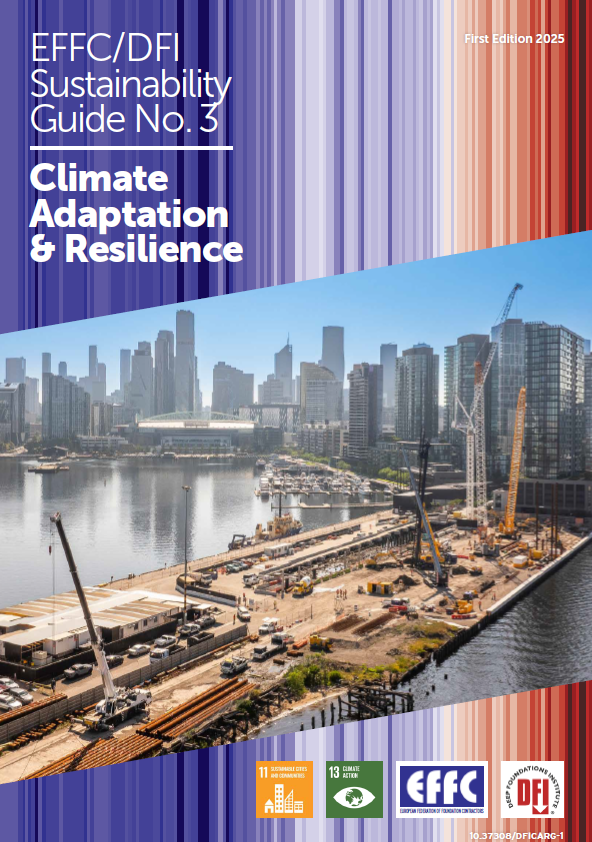
The latest guide, EFFC/DFI Sustainability Guide No.3: Climate Adaptation & Resilience, focuses on climate adaptation and resilience to address SDGs 11 (Sustainable Cities and Communities) and 13 (Climate Action). While other EFFC-DFI guides focus on how to mitigate climate change, the focus of this guide is on adapting geotechnical designs and construction practices to be more resilient to the world that we will be living in where climate change is occurring rapidly.
“This guide brings together key concepts, practical actions and case studies to help geotechnical companies adapt to a changing climate,” says Luke Deamer, Eng.D., FGS, Keller, and co-chair of the EFFC/DFI Sustainability Guides Task Group. “It’s amazing to see how climate adaptation and mitigation impacts every role in a company, from design and site operations through to procurement and equipment decisions.”
The first guide in the series, EFFC/DFI Sustainability Guide No. 1: Carbon Reduction, addresses SDGs 13 (Climate Action) 7 (Renewable and Clean Energy).
The second guide in the series, EFFC/DFI Sustainability Guide No. 2: Circular Economy, focuses on SDG 12 (Responsible Consumption and Production).
The guides are not minimum requirements or sector standards, but rather practical support guides sharing good practice. The guides are free and can be downloaded from the DFI Publications Store.